
How light, materials, textures and the psychology of perception help create spaces people truly enjoy living in
Why do some interiors feel inviting and comfortable within the first few minutes, while others – despite expensive furniture and exclusive materials – make us want to leave as quickly as possible?
The answer is not found in aesthetics alone. A successful interior affects us on a much deeper level – through light, materials, proportions, textures and the way people perceive space. Many of these reactions developed long before architecture and design took on their modern form.
Over hundreds of thousands of years, humans learned to recognize safe and pleasant environments. Our brain still responds to certain forms, materials and spatial structures – even when we are not consciously aware of it.
That is why some spaces feel warm and inviting, while others appear cold and distant.
Below, we look at the most important principles that help create interiors people are happy to return to every day.
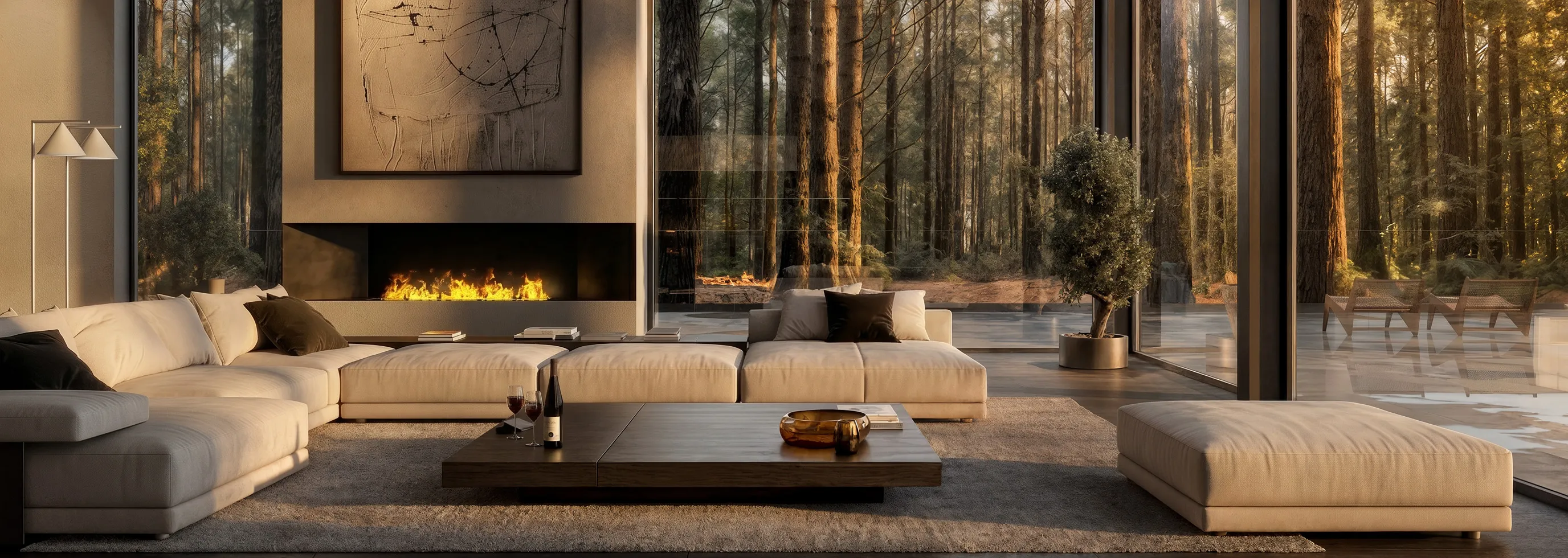
01.
Light and Spatial Perception
Light defines the atmosphere of a room.
Light is one of the most powerful tools in interior design. Throughout human history, sunlight shaped our daily rhythm. Bright daylight stood for activity and work, while the warm tones of sunset signaled the end of the day and the time for rest.
That is why we intuitively feel drawn to softer and more local light in the evening. However, comfort is not created by one specific color temperature, but by a well-considered lighting concept.
Professionally planned interiors take different lighting scenarios into account – for work, communication, cooking, reading and relaxation.
Practical tip: Plan lighting not according to rooms, but according to life situations.
Example: In the morning, functional light with 4000-4300 Kelvin can be used in the kitchen or home office. In the evening, a floor lamp next to the sofa, lighting for a bookshelf or decorative niche lighting with 2700-3200 Kelvin is often enough. The room immediately feels more relaxed and more comfortable.
02.
The Human Connection to Nature
Natural materials create an emotional connection to nature.
Humans existed long before modern building materials. For most of our history, we were surrounded by wood, stone, water and vegetation. That is why natural materials are still perceived as familiar and safe today.
This effect can partly be explained by the biophilia hypothesis of the American biologist Edward O. Wilson. It suggests that humans have an innate need to be connected with nature and natural systems. Today, this idea forms the basis of biophilic design – one of the most influential approaches in modern architecture and interior design.
We respond unconsciously to the grain of wood, the structure of natural stone and natural irregularities. These exact qualities give a room authenticity and life.
Practical tip: Integrate a few genuine natural materials and allow them to become important design elements.
Example: A solid wood dining table, linen curtains, a wool rug or a natural stone countertop can change the perception of an interior more strongly than a large number of decorative accessories.
03.
Textures Create Depth and Life
Look more closely at nature. Leaves, tree bark, stones, sand or clouds – hardly any surface is completely smooth. Our brain is trained to perceive complex environments with different structures. That is why rooms without textures often feel flat and characterless, even when high-quality materials are used.
Textures allow light to interact with surfaces. They create subtle shadow patterns and give rooms visual depth.
Practical tip: The calmer the color palette of an interior, the more important different surface structures become.
Example: A living room can be designed almost entirely in beige tones and still feel refined and expressive – through the combination of textured plaster, wood, linen fabrics, wool textiles and handmade ceramics.
04.
Why Rooms Should Feel Natural
Humans love the play of light and shadow.
If you look at a forest on a sunny day, you notice that light is never distributed evenly.
It passes through leaves, reflects on surfaces and creates a complex pattern of light and shadow. This is exactly the kind of environment in which humans developed over thousands of years. That is why rooms with depth of light feel more natural and pleasant.
Uniform lighting often makes rooms appear flat. Shadows, on the other hand, create atmosphere, emphasize architecture and strengthen the effect of materials.
Practical tip: Do not try to illuminate every area of a room equally brightly.
Example: Complement ceiling lights with wall lights, a reading lamp or lighting for niches and shelves. This creates a much more pleasant evening atmosphere.
05.
Fire Has Remained a Symbol of Security for Thousands of Years
For most of human history, fire meant life. It provided warmth, protection and light, and brought people together after sunset. That is why watching a flame still has a calming effect today. Our brain connects fire with safety and control over the environment.
Even today, many people can look at a campfire, a fireplace or a candle for hours. It is one of the oldest forms of relaxation for our nervous system.
Practical tip: Integrate a living light source if the spatial conditions allow it.
Example: A fireplace, a bioethanol fireplace or a group of several candles can completely change the atmosphere of a room in the evening.
06.
The Psychology of Safety and Comfort
We want to have an overview of the room while feeling protected at the same time.
In 1975, British geographer Jay Appleton formulated the so-called prospect-refuge theory. According to this theory, people feel particularly comfortable in environments where they can clearly observe their surroundings while also experiencing a sense of protection.
This mechanism originated in prehistoric times and still influences our perception of spaces today. That is why many people intuitively choose seats against the wall in restaurants, prefer to sit with a view of the entrance or feel uncomfortable when their back is turned to a door.
Practical tip: Design work and relaxation areas in such a way that they offer a good overview of the room while also providing visual support from behind.
Example: Ideally, a desk should be positioned so that the entrance to the room is visible. In a bedroom, it is advisable to place the bed so that the door can be seen from the bed without being located directly behind the headboard. In a living room, a sofa often feels more comfortable when there is a wall, bookshelf or room divider behind it.
07.
Soft Forms Encourage Relaxation
In nature, perfectly straight lines are rare. Coastlines, rivers, clouds and hills usually follow organic forms. Our brain perceives such forms as more natural and pleasant.
That is why rounded shapes often convey a feeling of calm and security. However, this does not mean that straight lines are bad. They create structure, order and architectural clarity. But rooms made only of strict geometric forms can quickly feel too formal.
The best interiors are created through the interplay of structure and softness.
Practical tip: If a room feels too strict or too rational, complement it with organic forms.
Example: A round mirror, an oval dining table, an organically shaped coffee table or an armchair with soft contours can make the atmosphere of a room feel noticeably more relaxed.
08.
An Interior You Do Not Only See, But Feel
An interior should appeal to all the senses.
Most people initially judge a room with their eyes. In reality, however, we perceive interiors much more comprehensively. We feel materials, hear the acoustics of a room, notice smells and constantly interact with surfaces through touch.
That is exactly why the quality of a luxurious interior cannot be judged by photographs alone.
True quality only becomes visible in everyday experience.
Practical tip: Plan spaces not only visually, but also haptically and atmospherically.
Example: A wool rug, natural wood, linen fabrics and well-balanced room acoustics influence well-being every day – even when we are barely consciously aware of them anymore.
09.
Rooms Need Rhythm
Visual order creates harmony.
Just as music lives from rhythm, a successful interior lives from repetition and structure. Recurring materials, lines, colors and forms help the brain understand a room more quickly and feel safe within it.
When an interior follows a clear design logic, it appears harmonious and balanced.
Practical tip: Repeat important materials and design elements in different areas of the room.
Example: If wood is used for the dining table, the same material can be repeated in furniture, wall cladding or decorative accessories. This creates a coherent overall impression.
10.
Rooms Need Air
Generosity influences our perception of luxury.
One of the most common mistakes is filling every free square meter with furniture and decoration. However, the feeling of luxury often does not come from the number of objects, but from the space between them.
For thousands of years, open areas offered humans a better overview, more daylight and a stronger sense of safety. Perhaps this is why generous spaces are still perceived as particularly pleasant and high-quality today.
Practical tip: Do not try to use every area of a room to its maximum capacity.
Example: Removing an armchair, a side table or a decorative object can often improve the effect of a room more than adding new furniture. Free space allows architecture, light and furnishings to have a stronger impact.
11.
True Luxury Means Comfort
Good interior design improves quality of life.
A high-quality interior is no longer merely about demonstrating status. Modern luxury is reflected in the quality of everyday life. It is reflected in how pleasant a space is to use, how intuitively it functions and how naturally it supports the habits of its residents.
A beautiful interior attracts attention. A comfortable interior improves life.
Practical tip: Ask yourself one simple question with every decision: “Does this element truly improve my everyday life?”
Example: A high-quality reading chair by the window often brings more joy and value than an expensive decorative object that exists only for a beautiful photograph.
Conclusion:
Comfort is not created by a single piece of furniture, a wall color or a short-lived trend.
It is created through the interaction of many factors: light, natural materials, thoughtful spatial planning, tactile qualities, proportions and the connection between humans and nature.
This is precisely where the true architecture of comfort lies – in creating spaces that not only look beautiful, but help people feel better every day.